How to Calculate Percentage Increase and Decrease
By kabeer Ahmad on
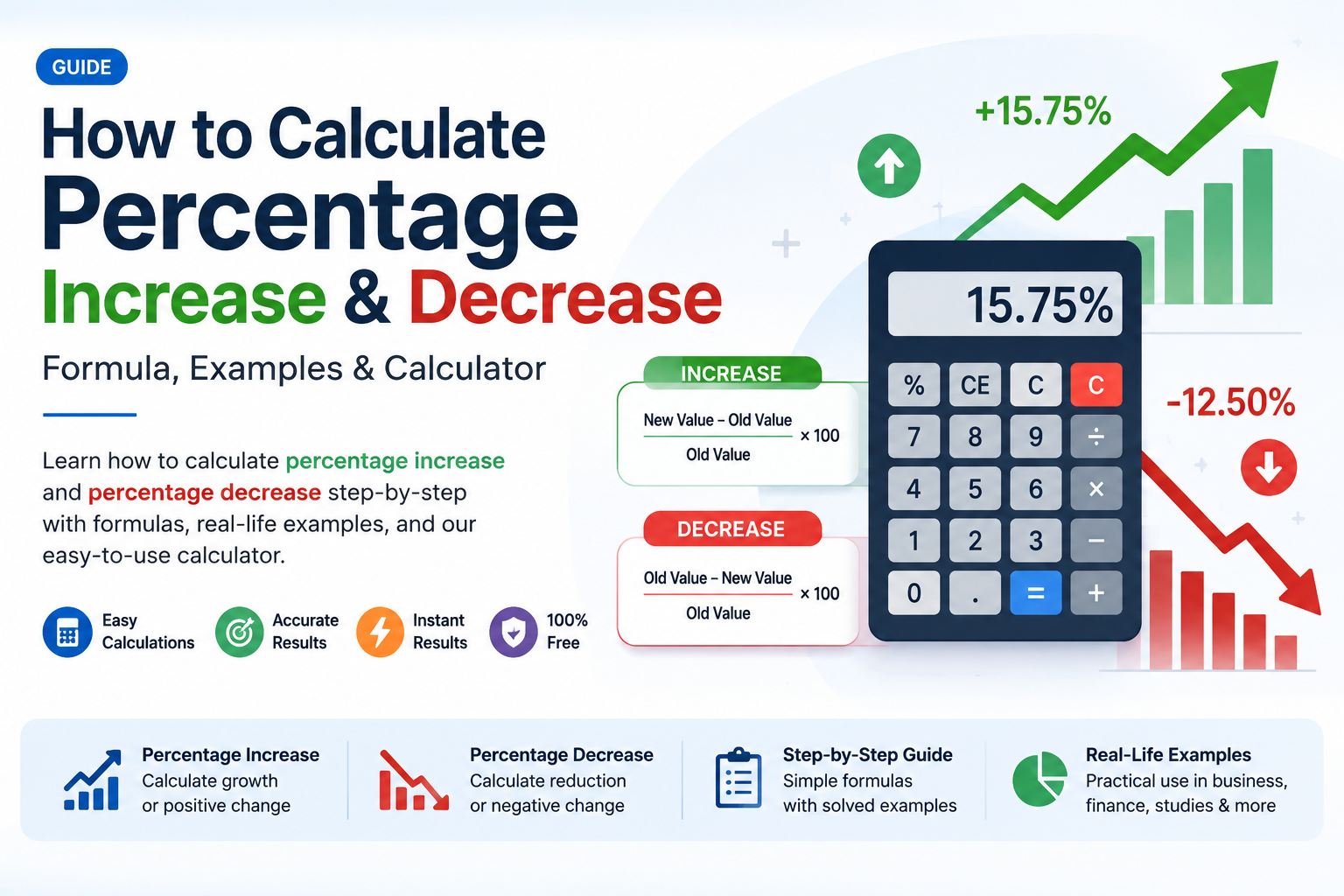
Learn how to calculate percentage increase and decrease with easy formulas, practical examples, and free online calculators.
Percentage increase and percentage decrease are useful for understanding how much a value has grown or fallen compared with its original value. Whether you are calculating a salary increase, a price change, a discount, business growth, exam results, or a reduction in expenses, the same basic percentage formulas can help.
Calculate Percentage Increase or Decrease Instantly
Don't want to calculate it manually? Enter your original and new values in our free percentage calculator and get the result instantly.
How to Calculate Percentage Increase
A percentage increase tells you how much a value has increased compared with its original value. It is commonly used when comparing an old price with a new price, calculating salary raises, measuring business growth, or analyzing changes over time.
Percentage Increase = ((New Value − Original Value) ÷ Original Value) × 100
The important part of this formula is that the difference is divided by the original value. The original value is your starting point.
Steps to Calculate Percentage Increase
- Subtract the original value from the new value.
- Divide the difference by the original value.
- Multiply the result by 100.
- The final number is the percentage increase.
Example: A Salary Increase
<p>
  Suppose your salary increased from <strong>Rs. 200,000</strong> to
  <strong>Rs. 230,000</strong>.
</p>

<p>Increase = Rs. 230,000 − Rs. 200,000 = <strong>Rs. 30,000</strong></p>

<p>Percentage Increase = (30,000 ÷ 200,000) × 100</p>

<div class="pc-result">Percentage Increase = <strong>15%</strong></div>
You can also calculate this instantly using our Percentage Increase Calculator .
How to Calculate Percentage Decrease
Percentage decrease tells you how much a value has fallen compared with its original value. It is commonly used for discounts, price reductions, decreases in expenses, reduced sales, or changes in measurements.
Percentage Decrease = ((Original Value − New Value) ÷ Original Value) × 100
Steps to Calculate Percentage Decrease
- Subtract the new value from the original value.
- Divide the difference by the original value.
- Multiply by 100.
- The result is the percentage decrease.
Example: A Price Reduction
<p>
  A product originally costs <strong>Rs. 8,000</strong> and its price is
  reduced to <strong>Rs. 6,000</strong>.
</p>

<p>Decrease = Rs. 8,000 − Rs. 6,000 = <strong>Rs. 2,000</strong></p>

<p>Percentage Decrease = (2,000 ÷ 8,000) × 100</p>

<div class="pc-result red">Percentage Decrease = <strong>25%</strong></div>
For a quick calculation, use our Percentage Decrease Calculator .
Percentage Increase and Decrease Examples
Here are some common examples to make percentage changes easier to understand.
| Original Value | New Value | Change | Result |
|---|---|---|---|
| 100 | 120 | Increase | 20% |
| 500 | 450 | Decrease | 10% |
| 1,000 | 1,250 | Increase | 25% |
| 2,000 | 1,500 | Decrease | 25% |
Percentage Increase vs Percentage Decrease
The formulas are very similar, but the direction of the change determines which formula you should use.
📈 Percentage Increase
  <p>Use this when the new value is greater than the original value.</p>

  <p>
    <strong> (New − Original) ÷ Original × 100 </strong>
  </p>

  <a href="/percentage-increase-calculator">
    Calculate Percentage Increase →
  </a>
</div>

<div class="pc-card">
  <h3>📉 Percentage Decrease</h3>

  <p>Use this when the new value is smaller than the original value.</p>

  <p>
    <strong> (Original − New) ÷ Original × 100 </strong>
  </p>

  <a href="/percentage-decrease-calculator">
    Calculate Percentage Decrease →
  </a>
</div>
If you are comparing two numbers and neither one is necessarily the starting value, you may need a different calculation. Learn more with our Percentage Difference Calculator .
Where Are Percentage Increase and Decrease Used?
Percentage change is used in everyday life as well as in business, education, finance, shopping, and data analysis.
💰 Salary Increases
Compare your old salary with your new salary to calculate your percentage raise.
<div class="pc-card">
  <h3>🛍️ Discounts</h3>
  <p>
    Calculate how much a product price has decreased during a sale or
    promotion.
  </p>
</div>

<div class="pc-card">
  <h3>📊 Business Growth</h3>
  <p>
    Measure increases in revenue, customers, sales, traffic, or other
    business metrics.
  </p>
</div>

<div class="pc-card">
  <h3>📚 Education</h3>
  <p>Compare marks, scores, test results, and other numerical changes.</p>
</div>
For shopping calculations, you can also use our Discount Calculator to quickly find the discount amount and final price.
Common Percentage Calculation Mistakes
1. Using the new value instead of the original value
When calculating percentage increase or decrease, the original value is normally the reference point. Dividing by the new value can produce a different result.
2. Forgetting to multiply by 100
The decimal result must be multiplied by 100 to convert it into a percentage.
3. Confusing percentage change with percentage difference
Percentage increase and decrease use an original value as the reference point. [Percentage difference](/percentage-difference-calculator) uses the average of the two values as its reference. Learn more on our Percentage Difference Calculator page.
4. Assuming a 20% increase followed by a 20% decrease returns to the original value
It does not. Percentages are calculated relative to the value at the time of each change.
Start with 100. A 20% increase gives 120.
<p>A 20% decrease from 120 gives 96.</p>

<div class="pc-result red">Final value = 96, not 100.</div>
Can You Calculate a Percentage Change Backwards?
Yes. Sometimes you know the final value and the percentage change but need to find the original value.
This is known as a [reverse percentage calculation](/reverse-percentage-calculator) and is useful for working backwards from sale prices, increased prices, salaries, taxes, and other values.
Use our Reverse Percentage Calculator when you need to find the original value.
Calculate Percentage Increase or Decrease Online
You don't need to perform every calculation manually. Our free Percentage Calculator makes it easy to calculate percentages quickly and accurately.
Simply enter your numbers, choose the calculation you need, and get your result instantly.
Ready to Calculate?
<p>
  Try our free percentage calculator or choose a specialized calculator for
  percentage increase, decrease, difference, discounts, and more.
</p>

<div class="pc-button"><a href="/">Open Percentage Calculator →</a></div>
Frequently Asked Questions
How do I calculate percentage increase?
Subtract the original value from the new value, divide the result by the original value, and multiply by 100.
How do I calculate percentage decrease?
Subtract the new value from the original value, divide by the original value, and multiply by 100.
What is the formula for percentage increase?
Percentage Increase = ((New Value − Original Value) ÷ Original Value) × 100.
What is the formula for percentage decrease?
Percentage Decrease = ((Original Value − New Value) ÷ Original Value) × 100.
What is the difference between percentage change and percentage difference?
Percentage change compares a new value with an original value. Percentage difference compares two values using their average as the reference point.
How do I calculate a salary increase percentage?
Subtract your old salary from your new salary, divide the difference by your old salary, and multiply by 100.
How do I calculate a discount percentage?
Subtract the sale price from the original price, divide the discount amount by the original price, and multiply by 100.
Can a percentage decrease be more than 100%?
When measuring a decrease from a positive original value to zero, the decrease is 100%. A decrease beyond zero requires additional context because ordinary percentage-decrease calculations are based on the original value.
Related percentage calculators
Use a focused calculator when your question needs a different baseline or a price-specific formula.
Percentage Calculator
Find a percentage, percentage ratio, or percentage change.
Percentage Increase Calculator
Measure how much a value has grown from its starting point.
Percentage Decrease Calculator
Work out the percentage reduction from an original value.
Percentage Difference Calculator
Compare two values when neither one is the original baseline.
Reverse Percentage Calculator
Find an original amount from a final value and percentage.
Discount Calculator
Calculate the amount saved and the final sale price.