How to Calculate CBM (Cubic Meter) for Shipping: Formula, Examples and Free Calculator
By kabeer Ahmad on
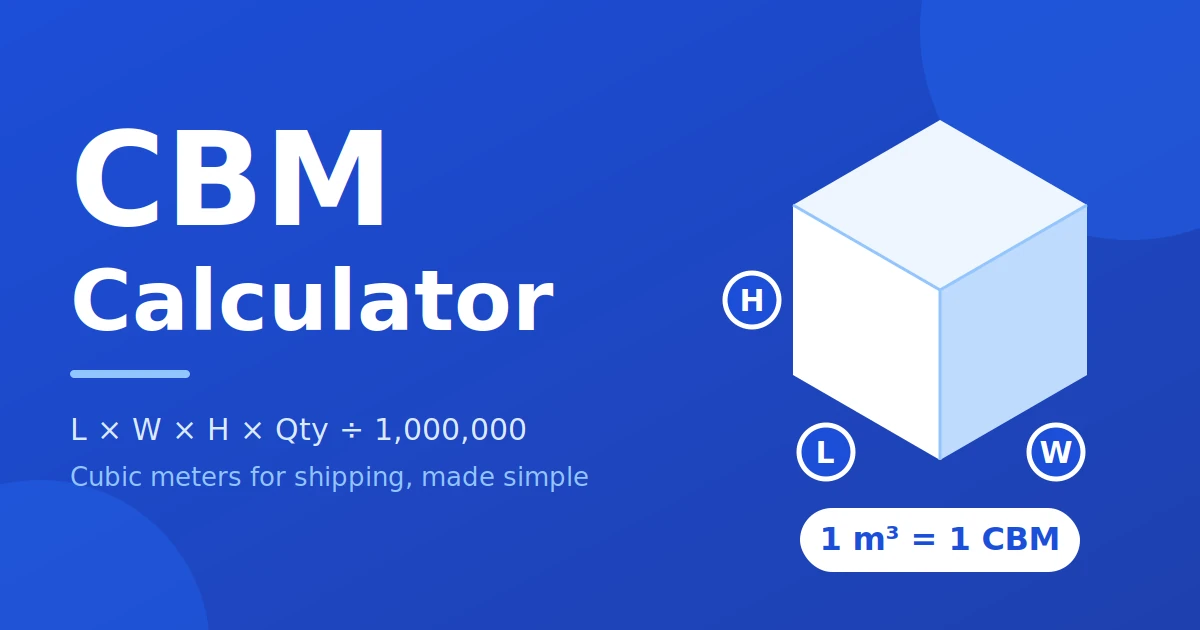
Learn how to calculate CBM for shipping with the simple formula, worked examples in cm, mm and inches, and a free CBM calculator for multiple carton sizes.
If you import, export or sell products online, you will see the term CBM on almost every shipping quote. CBM tells a freight company how much space your cartons take up. In this guide, you will learn how to calculate CBM with one simple formula. We cover centimeters, millimeters, inches and meters, and show a full example with several carton sizes. You can also use our free CBM calculator to get the answer instantly.
What Is CBM?
CBM stands for cubic meter. It is the standard unit for measuring cargo volume in shipping. One CBM is the space taken by a box that is 1 meter long, 1 meter wide and 1 meter high.
Freight forwarders use CBM to plan container space and to price sea freight, especially LCL (less than container load) shipments. If you know your CBM, you can compare quotes and estimate how much of a container you need.
The CBM Formula
The basic CBM formula uses meters:
CBM = Length (m) × Width (m) × Height (m) × Number of cartons
Most cartons are measured in centimeters, so you can use this version instead:
CBM = Length (cm) × Width (cm) × Height (cm) × Quantity ÷ 1,000,000
Here are the conversion factors for each unit:
| Unit | Divide the total by |
|---|---|
| Centimeters (cm) | 1,000,000 |
| Millimeters (mm) | 1,000,000,000 |
| Inches (in) | 61,023.7441 |
| Meters (m) | 1 |
Always use the outer carton size, including the packaging. Do not use the size of the product inside.
How to Calculate CBM Step by Step
- Measure the length, width and height of one carton.
- Multiply the three numbers together.
- Divide by the conversion factor for your unit (1,000,000 for cm).
- Multiply by the number of cartons.
- Repeat for each carton size and add the results.
Worked Example in Centimeters
A carton measures 70 × 51 × 35 cm.
70 × 51 × 35 = 124,950
124,950 ÷ 1,000,000 = 0.12495 CBM per carton
For 10 cartons: 0.12495 × 10 = 1.2495 CBM
Worked Example in Millimeters and Inches
Millimeters: A carton measures 700 × 510 × 350 mm.
700 × 510 × 350 = 124,950,000
124,950,000 ÷ 1,000,000,000 = 0.12495 CBM
It is the same carton as above, so the answer matches.
Inches: A carton measures 20 × 20 × 20 inches.
20 × 20 × 20 = 8,000
8,000 ÷ 61,023.7441 = about 0.1311 CBM per carton
For 25 cartons: 0.1311 × 25 = about 3.2774 CBM (using the unrounded figure).
How to Calculate CBM for Multiple Carton Sizes
Real shipments often include more than one box size. Work out each size separately, then add them together.
| Carton | Size (cm) | Quantity | CBM per carton | Total CBM |
|---|---|---|---|---|
| A | 70 × 51 × 35 | 10 | 0.12495 | 1.2495 |
| B | 60 × 40 × 40 | 20 | 0.096 | 1.92 |
| C | 50 × 30 × 30 | 15 | 0.045 | 0.675 |
| Total | 45 | 3.8445 |
The whole shipment is 3.8445 CBM.
Free CBM Calculator
You do not need to do this by hand. Our free CBM calculator lets you enter length, width, height, unit and quantity. It adds up several carton sizes, shows the formula for each row, and lets you copy the result.
Open the free CBM calculator →
Try the example numbers (70 × 51 × 35 cm, quantity 10) and check that you get 1.2495 CBM.
CBM vs Weight: What Carriers Actually Charge
CBM measures volume only. It does not tell you what a carrier will charge.
- Sea freight (LCL): carriers often bill on whichever is greater, the volume in CBM or the weight in tonnes.
- Air freight and couriers: carriers compare actual weight with volumetric weight. A common formula is Length × Width × Height (cm) ÷ 6,000, giving kilograms. Some couriers use 5,000. For the 70 × 51 × 35 cm carton, 124,950 ÷ 6,000 = 20.8 kg.
Always ask your carrier which rule and divisor they use.
Useful CBM Conversions
- 1 CBM = 1,000 liters
- 1 CBM = about 35.31 cubic feet
- A 20 ft container holds roughly 33 CBM, a 40 ft container roughly 67 CBM and a 40 ft high cube roughly 76 CBM. Usable space is a little lower because of packing gaps.
Common CBM Mistakes
- Using the wrong unit factor. Dividing centimeters by 1,000 instead of 1,000,000 gives a result 1,000 times too big.
- Measuring the product, not the carton. Packaging adds size.
- Rounding too early. Round only the final total.
- Forgetting pallets. Pallets and overhang add height and width.
- Assuming CBM is the price. CBM is volume. Rates, minimum charges and weight rules also matter.
Frequently Asked Questions
What does CBM mean in shipping?
CBM means cubic meter. It measures the volume of your cargo. Freight companies use it to plan space and to price shipments, mainly sea freight.
How do I convert cm to CBM?
Multiply length × width × height in centimeters, then divide by 1,000,000. For a 70 × 51 × 35 cm carton, the answer is 0.12495 CBM.
How many CBM fit in a 20ft or 40ft container?
A 20 ft container holds about 33 CBM, and a 40 ft container about 67 CBM. A 40 ft high cube holds about 76 CBM. Real usable space is slightly lower, so ask your forwarder.
Is CBM the same as chargeable weight?
No. CBM is volume. Chargeable weight is the greater of actual weight and volumetric weight, and the rules differ by carrier and transport mode.
Conclusion
CBM is simple once you know the formula: length × width × height × quantity, converted to cubic meters. Measure your outer cartons, pick the right unit factor and add up each size. Use our free CBM calculator to save time, and check your margins with our guide on how to calculate profit margin.
Results are estimates for planning. Actual freight charges depend on carrier rules, volumetric weight, minimum billing, packaging and other shipment details.
Related percentage calculators
Use a focused calculator when your question needs a different baseline or a price-specific formula.
Percentage Increase Calculator
Measure how much a value has grown from its starting point.
Percentage Decrease Calculator
Work out the percentage reduction from an original value.
Percentage Difference Calculator
Compare two values when neither one is the original baseline.
Reverse Percentage Calculator
Find an original amount from a final value and percentage.
Discount Calculator
Calculate the amount saved and the final sale price.
VAT Calculator
Add VAT to a net price or remove it from a gross total.